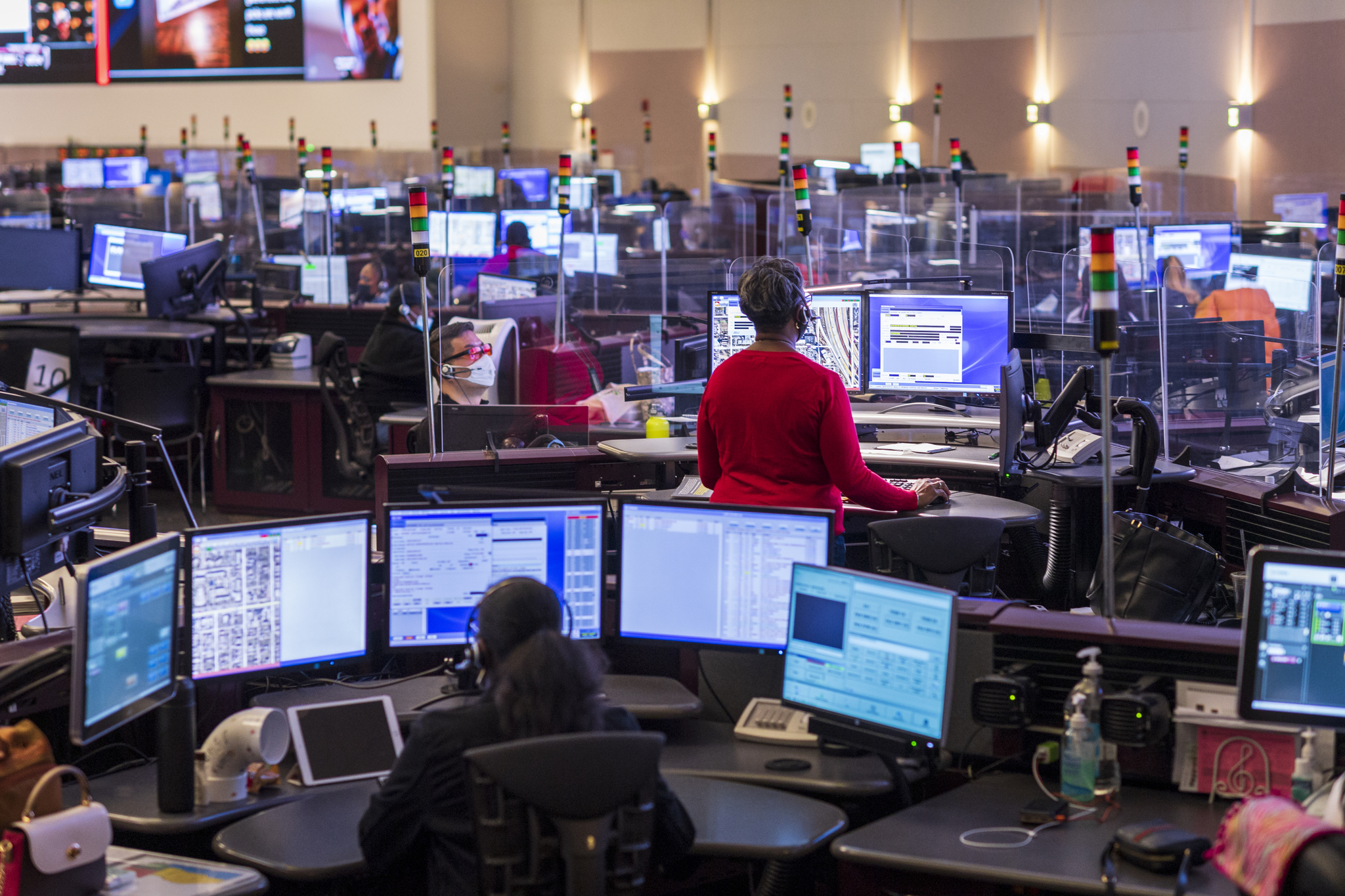
Non-emergency calls are overwhelming PSAPs. Traditional diversion strategies have hit their ceiling. A new generation of conversational AI is changing how centers handle intake—and early adopters are seeing real relief.
The calls are familiar to anyone who's spent time in a comm center. A dog that won't stop barking. Fireworks—again. Someone who isn't sure where else to turn and knows 911 will pick up. A complaint that won't require a unit but still requires time to process.
This has always been part of the job. What's different now is the scale.
Across the United States, roughly 240 million calls are placed to 911 each year, according to the National Emergency Number Association. The headline number matters less than what sits underneath it: in many centers, most of those calls don't result in the dispatch of emergency resources. The exact percentage varies, but operationally, the pattern holds.
This isn't a nuisance problem anymore. It's a capacity problem.
911 as the default front door
More and more, PSAPs function as the 24/7 front door to local government. When 311 systems close overnight, run lean, or don't exist at all, callers default to the number they trust. From their perspective, this makes sense. From a comm center's perspective, it steadily erodes focus and bandwidth.
The challenge isn't just volume. It's contrast. Telecommunicators move from a high-acuity call involving violence or cardiac arrest directly into a low-urgency complaint about a parking ticket—and that complaint still requires professionalism, patience, and documentation. Task-switching like that isn't just tiring. It increases cognitive load and reduces resilience over the course of a shift.
Staffing realities make it worse. Both APCO and NENA have documented persistent vacancies, mandatory overtime, and burnout across the profession. Absorbing growing non-emergent demand with the same staffing model becomes harder every year.
Why diversion hasn't been enough
For decades, jurisdictions have tried to solve this by moving calls elsewhere.
311 systems, civilian admin desks, online portals, callback queues—they all exist for good reasons, and in many cities, they've helped. Research on early 311 implementations in Baltimore, New York, and Chicago showed meaningful reductions in 911 call volume after launch.
But those same studies revealed something PSAP leaders recognize immediately: new channels don't just divert demand, they often create it. When government makes itself easier to reach, people use it more. Some of that demand would have gone to 911 anyway. Some of it wouldn't have existed at all.
Diversion isn't a failure. It's just not a silver bullet.
What many centers are hitting now is the ceiling of traditional diversion strategies—especially in jurisdictions without the funding or political support to stand up a fully staffed, 24/7 311 operation.
A different approach to intake
In that context, some agencies have started experimenting with a different model: not redirecting callers away from the phone, but changing how the phone is answered.
The idea is straightforward. If a large share of inbound calls are informational, transactional, or administrative, the first point of contact doesn't always need to be a telecommunicator—as long as there are reliable paths to escalation when something doesn't fit the script.
This is where conversational AI has entered the discussion.
Unlike traditional IVRs—rigid menus that force callers to self-diagnose—newer systems can answer immediately, ask clarifying questions, and resolve routine requests while staying alert for signs of higher acuity. Conceptually, it's closer to a well-trained admin intake desk than a phone tree.
Adoption so far has been limited to non-emergency and business lines—not 911 itself. Using AI to answer emergency calls directly would run counter to industry practice and NENA's call-answering standards, which emphasize immediate human contact. When Kalamazoo County implemented AI call handling in December 2024, for example, it was exclusively for non-emergency intake. Emergency calls still go to human dispatchers.
That distinction signals how leaders are thinking about risk.
Why this moment is different
PSAPs didn't just discover automation. They've been experimenting with call trees, overflow desks, and diversion strategies for decades. What's changed is the technology's ability to participate meaningfully in intake, rather than simply deflect it.
Until recently, automated systems were brittle by design. They required callers to self-classify, followed rigid paths, and broke down under stress—exactly the conditions that define public safety communications. That limitation shaped policy as much as technology: automation was tolerated only at the margins and never trusted with ambiguity.
Conversational AI changes that equation. For the first time, systems can ask follow-up questions, detect intent across unstructured speech, summarize context, and adapt routing in real time. The result isn't a replacement for human judgment, but a new kind of intake layer that can absorb volume, surface risk, and do so consistently—even during surge events.
That shift—from rigid automation to adaptive intake—is why this conversation is happening now, and why it's moving beyond pilots. Not because AI is novel, but because it's finally useful in the specific, unforgiving conditions of emergency communications.
What early adopters are seeing
A handful of public-facing case studies help illustrate what this looks like in practice.
La Crosse County, Wisconsin, went live with AI-powered non-emergency call handling in May 2025. Of the roughly 140,000 calls the county received in 2024, only 35,000 were true 911 calls—the rest were administrative. The AI system handled over 40,000 calls in its first months of operation. Operations Supervisor Cory Lynch told Wisconsin Public Radio that the system allows dispatchers to focus on emergencies without putting non-emergency callers on hold during critical incidents.
In Cowlitz County, Washington, the stakes became clear during the Fourth of July—the busiest day of the year for any comm center. Operations Manager Michelle Arrowsmith reported that dispatchers could finally take breaks during surge periods for the first time, as the AI absorbed the predictable flood of fireworks complaints while the team stayed locked in on emergencies. Over 20,000 calls were handled automatically, with 55% resolved without dispatcher involvement and 10.5% correctly identified as emergencies and escalated to human call-takers.
MACECOM in Mason County, Washington, saw 63% of AI-processed calls generate calls for service, freeing up over 400 hours in two months. Executive Director Joe Schmit noted that the system's ability to stay on calls as long as needed—without the pressure to clear the line for the next call—meant routine callers got better service, not worse.
These examples don't prove automation belongs everywhere. They show something more modest: when non-emergent demand dominates volume, changing the intake model can materially change how a center experiences that load.
Where risk lives
The primary risk in any automated intake system is misclassification—especially when a caller understates urgency or doesn't yet understand the seriousness of their situation. This isn't hypothetical. Any system that touches call handling must assume some emergencies will initially present as non-emergent.
There are second-order risks, too. Public-sector AI systems have drawn criticism in other domains for delivering incorrect information when guardrails are weak. Expectation creep is another concern: when callers learn they'll always get an immediate answer, volume can increase rather than stabilize.
None of these risks are reasons to dismiss the approach outright. They are reasons to keep implementations narrow, escalation paths obvious, and human oversight central.
What this means for operations
Non-emergent demand isn't going away. Staffing constraints aren't easing. The traditional tools—311, callbacks, scripts, and IVRs—have real but limited upside.
For centers where administrative calls dominate daily volume, rethinking the first point of contact may offer a way to reclaim capacity without lowering service quality or burning out staff. Automation doesn't replace people. It uses people where they matter most.
The most telling signal isn't the technology itself. It's the way early adopters describe outcomes: quieter phones, fewer interruptions, more focus on emergencies, and a workload that feels survivable.
Kalamazoo County's Deputy Director Torie Rose put it simply: "The phone used to ring off the hook. Now it no longer does. It's more of a peaceful lull."
That change—more than any percentage point—is why this conversation is gaining traction.
Like it or not, AI is coming to emergency communications. The question isn't whether it belongs in the comm center. The question is where it belongs, how it's deployed, and whether it makes your telecommunicators' jobs easier or harder. Early evidence suggests it can be a game-changer—but only if it's built for the unique, high-stakes environment of public safety and kept on the shortest possible leash.
The centers getting this right aren't replacing human judgment. They're protecting it.